How SMS credits work
What this covers
The model behind text messaging: what a credit is, where your balance comes from, and what happens
when it runs out. Requires the manage-billing permission — Owner, or a Manager your Owner
has given billing access (link Roles and permissions).
Prepaid, so there is never a surprise bill
Text messages cost real money to send, and unlike email that cost is per message. Tabledoo handles this with credits you hold in advance: each text spends some of your balance, and when the balance is gone, texts stop.
That is a deliberate choice in your favour. The alternative — metered billing — means a misconfiguration or an unusually busy month arrives as an invoice you did not expect. With credits, the most a mistake can cost you is the balance you chose to hold.
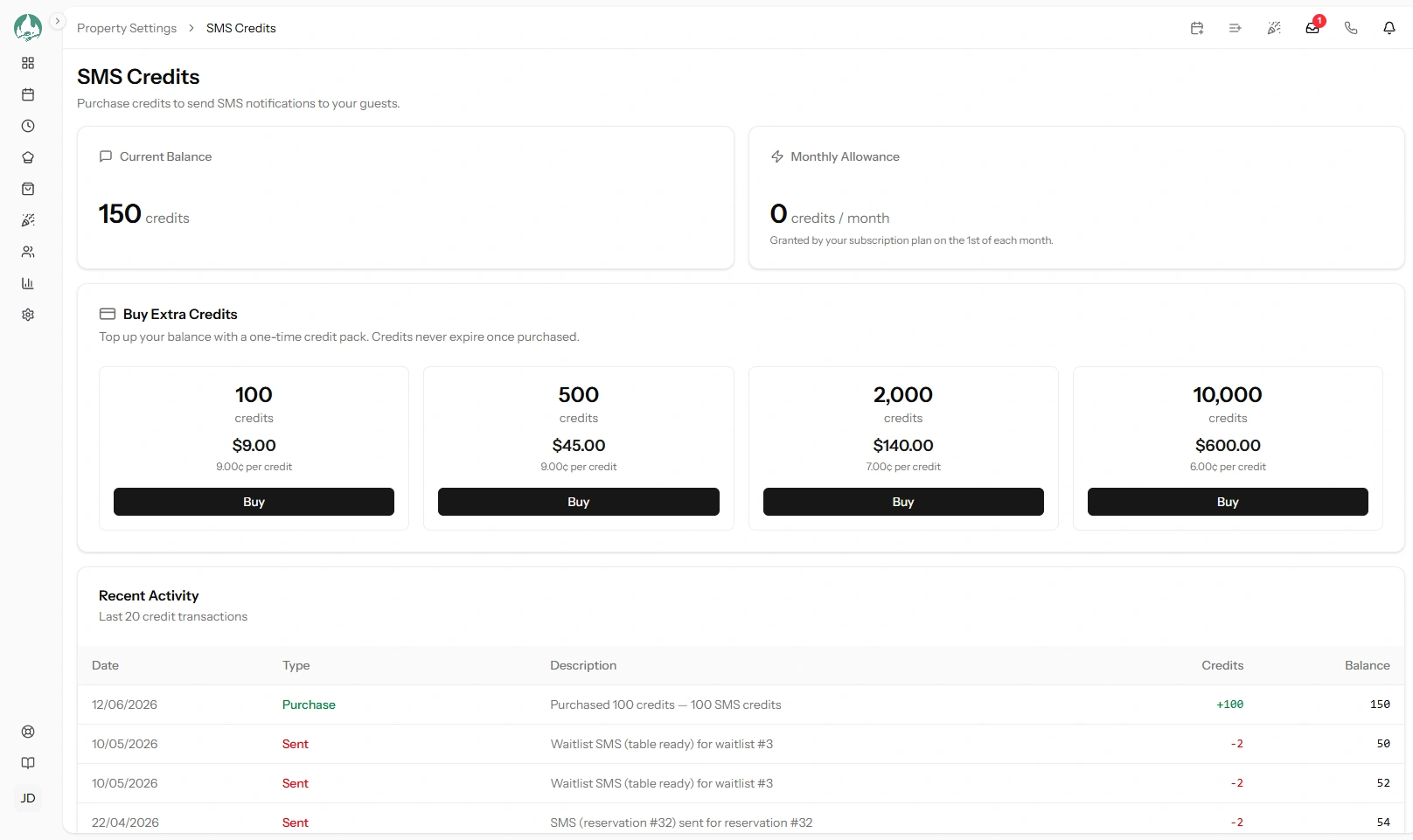
Where your balance comes from
Two sources, and they go into the same pot:
| Source | How you get it | Cost |
|---|---|---|
| Monthly allowance | Added automatically on the 1st of each month, if your plan includes one | Included in your subscription |
| Credit packs | Bought whenever you want, on any plan | A one-off card payment |
Once credited, both behave identically — there is one balance, and messages spend from it. See Your monthly allowance and Buying credit packs.
Where to see your balance
Two places:
- Property Settings → SMS Credits (
/settings/sms-credits) — the full page: your balance, your monthly allowance, the packs you can buy, and your recent credit history. - Property Settings → Notifications — the balance is shown beside the SMS switches, with a top-up link, so you see it at the moment you are deciding what to send.
What a message costs
Between one and three credits, depending on which country the guest's mobile number belongs to — because that is how carrier pricing works. A text to a nearby country costs less than one to the other side of the world. Covered in What an SMS costs in credits.
What happens at zero
This is the important part, because the behaviour is quiet.
- Texts are skipped. Not queued, not delayed — skipped. Topping up later does not send the messages you missed; that moment has passed.
- Email carries on normally. Every email type is unaffected, because email costs nothing.
- Nothing warns you. There is no alert when your balance runs low or reaches zero. Your guests keep getting emails, your staff see no errors, and nobody notices.
That combination is why it is worth making a habit of glancing at the balance. A restaurant relying on waitlist texts can lose covered tables for a fortnight before anyone works out why guests stopped coming back to the host stand (link Waitlist messages).
A simple rule
Look at the number whenever you open the notification settings, and top up when it drops below about two weeks of normal use. Once you have a month of history you can read your own rate straight off the credit history (link Your credit history).
Good to know
Credits are for guest text messages only. They are not used for emails, for the chatbot, or for anything else. Nothing else in Tabledoo can spend them.
If a message fails after the credits were taken, they come back. Automatically, with a matching entry in your history — so a provider problem never quietly costs you.
Your balance is not tied to your plan's billing cycle. Credits you hold are yours; changing plan does not clear them.
Turning SMS off does not spend anything. If you are unsure whether texts are worth it, leave the switches off — the balance simply sits there.