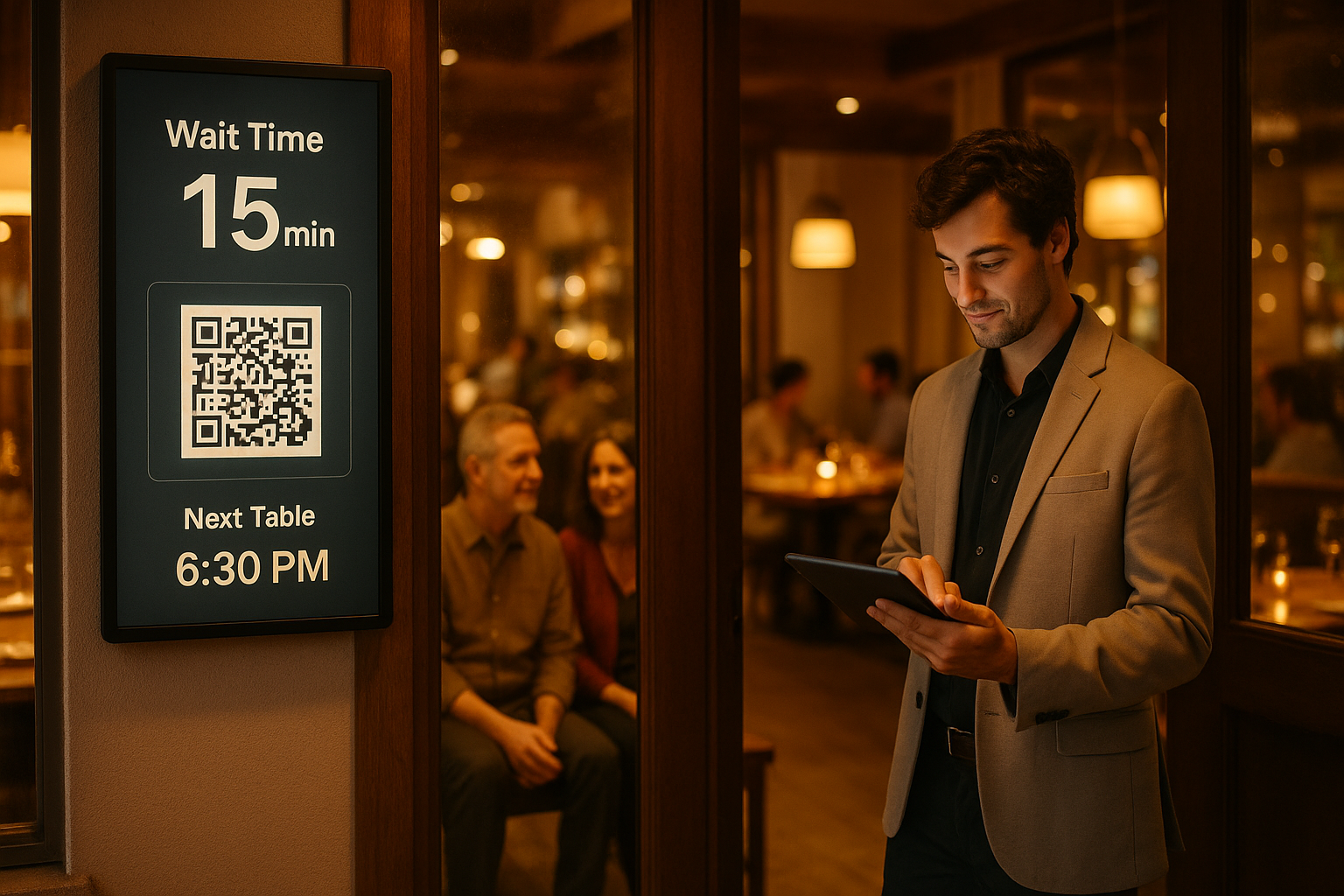
Digital signage is no longer just for flashy menu boards — when paired with the right front-of-house systems it becomes a real-time control panel that reduces perceived wait times, routes walk-ins into direct bookings, and smooths guest flow. For European operators juggling limited covers and high guest expectations, a small investment in screens and connected workflows can pay back in faster turn times, higher conversion of walk-ins to bookings, and fewer stressed staff on service nights.
Why digital signage moves the needle
Screens in the waiting area or at the entrance do three practical things: set guest expectations, give clear next steps, and surface operational truth. Research and industry reporting show digital menu and signage adoption in restaurants is mainstream and rising — over half of restaurant signage screens already display digital menus, a sign that venues are comfortable with screens as a guest touchpoint. (kitcast.tv)
Beyond adoption, studies indicate that visible queue information and relevant on-screen content reduce perceived waiting time — some field work and industry summaries report perceived wait-time reductions as large as one-third when signage is used as a distractor and communication tool. That’s not magic — it’s psychology: informed guests feel more in control and judge waits as shorter. (digital-signage-report.s3.amazonaws.com)
QR codes and mobile scanning have also matured as a guest behaviour across Europe, meaning screens that surface a QR booking code or a branded booking URL are more likely to convert a table-side scan into a direct reservation or order. Monthly QR usage continues to grow across many European markets, making this an increasingly reliable conversion channel. (wearesocial.com)
Practical workflows that map to Tabledoo features
Here are three operator-friendly workflows that turn signage into bookings and better throughput — each maps directly to Tabledoo capabilities.
Live wait-time & position display: Link your waitlist to a lobby screen so guests see estimated wait and their queue progress. When Tabledoo advances a party on the waitlist or marks a table ready from the Live View board, the screen updates in real time and guests receive the same notification by SMS or in-app message. The result: fewer anxious guests, fewer repeated host-desk checks, and faster seatings.
Promote the commission-free booking page and QR booking codes: Use a prominent slide that highlights your branded, commission-free booking page and an on-screen QR code that points to it. Guests scanning from the street or waiting tables land on your booking page and can reserve future slots without third-party fees. Tabledoo’s public booking page and menu/booking QR features make this immediate and trackable — you can measure how many walk-ins convert to direct bookings in your booking page funnel report.
Surface real-time table status and smart routing: A “live table board” on a screen can show which sections are clearing soon, where the next available two-top sits, and whether a server needs support. When combined with Tabledoo’s Live View and floor-plan data, hosts can make faster seating decisions and use the Quick-Seat workflow to move waitlist guests into freed tables without losing visibility.
Operational benefits: staff workload, upsell and data
Digital signage doesn’t replace staff — it empowers them. By reducing repetitive questions about wait time and where to queue, hosts can focus on high-value tasks: greeting, upselling, and smoothing service. When combined with Tabledoo guest notifications and a QR-enabled menu or ordering page, you also create natural, low-friction upsell moments (set-menu highlights, drink pairings, or event nights) directly from the screen to the guest’s phone.
Operational wins you can expect:
- Lower perceived wait and fewer seat-time disturbances — freeing hosts to manage flow rather than answer repeat queries.
- Higher conversion of transient footfall into tracked, commission-free reservations via QR or branded booking pages.
- Better pacing and fewer bottlenecks because the live table board and waitlist are synchronised across screens and staff devices.
All of this generates cleaner data: you’ll see which signage prompts drive bookings, which timeslots convert, and how wait-to-seat latency affects average spend — then optimise using Tabledoo’s utilisation and booking funnel reports.
Next steps
Start with a small pilot: add a single lobby screen, connect it to your waitlist and booking page, and run the display during peak service. Test a clear QR booking slide and a live wait-time view for two weeks, then review Tabledoo analytics to measure conversions and seat-times. If you’re ready to move faster, integrate multiple screens for section-level status and add targeted promotions during slower shifts.
Digital signage is a practical, measurable lever for any restaurant that wants to reduce stress at the host station, convert walk-ins into commission-free bookings, and improve guest perception of waiting. To see how these workflows work in Tabledoo — from waitlist to live table board, QR menu/booking pages and guest notifications — visit https://tabledoo.com